The Independent Operator's Guide to Smart Building Technology
The average apartment resident now receives three to four packages per week. That number has roughly tripled in the last decade, and the leasing offices at most 50 to 200 unit properties were built for none of it. No dedicated intake process. No after-hours access. No audit trail. Just a back room that fills up faster than staff can manage it.
Implementing effective multifamily package management solutions can significantly enhance resident satisfaction and retention.
With the right multifamily package management solutions, residents can expect more secure and convenient delivery experiences.
Investing in multifamily package management solutions not only addresses logistical challenges but also boosts overall property appeal.
This series will explore various multifamily package management solutions designed for properties of different sizes.
Understanding the benefits of multifamily package management solutions is crucial for property operators.
Choosing the right multifamily package management solutions can streamline operations and improve resident experiences.
Residents prefer properties that invest in multifamily package management solutions, enhancing their overall living experience.
Frustrations around package handling can be mitigated with effective multifamily package management solutions.
By utilizing multifamily package management solutions, properties can significantly reduce operational pain points.
Online reviews greatly reflect the effectiveness of multifamily package management solutions in addressing resident needs.
Properties utilizing multifamily package management solutions stand out in competitive markets.
Implementing multifamily package management solutions can bring about significant operational efficiencies.
Here’s what that means in practice: residents deal with delayed pickup windows, packages left in unsecured areas, and zero access after the office closes. Those friction points feel minor in isolation. But they accumulate. A resident who has filed two package complaints and posted one negative review about a stolen delivery is not renewing — regardless of how good the unit is.
Package management is a retention issue. That’s the reframe that matters. Operators who treat it as a logistics nuisance leave a meaningful renewal lever on the table. Operators who solve it competently — not expensively, just competently — create a daily experience that the property down the street probably isn’t matching.
Effective multifamily package management solutions create a seamless experience for residents.
This is the final post in a three-part series on smart building infrastructure for independent multifamily operators. Post 1 covers access control for apartment buildings. Post 2 covers smart locks vs. smart access control. This post closes the loop on the full entry experience — from the perimeter to the unit door to the package room — and maps the multifamily package management solutions available to operators under 200 units.
Table of Contents
Why Package Handling Affects Renewals, Reviews, and On-Site Labor
Residents rarely praise package handling when it works. They remember it when it fails. That asymmetry is the core of the business case.
A lease renewal decision rarely comes down to one dramatic event. It comes down to accumulated friction — the small moments that tell a resident whether the property takes their daily life seriously. Having to leave work early to pick up a box. Waiting while staff search a cluttered back room. Discovering that a package was signed for but never located. Those moments don’t disappear when renewal conversations happen. They’re already part of how the resident perceives the property.
What the Numbers Say
Resident satisfaction surveys consistently rank package management among the top operational pain points at apartment communities. Properties with unresolved package problems see those complaints surface in online reviews — and online reviews directly affect leasing velocity. A prospective resident reading about stolen packages or inaccessible pickup isn’t calculating whether that’s a dealbreaker. They’re already looking at the next listing.
On the revenue side: in competitive markets, properties with better amenity infrastructure — including package solutions — have demonstrated pricing power. A $25 to $75 monthly premium for a unit with 24/7 locker access is defensible when nearby competitors are still running a manual back-room process. Not every market supports that premium, but the NOI argument is real where supply is tight and residents have choices.
Relying solely on traditional methods without multifamily package management solutions may not suffice in today’s market.
Amazon Hub is one aspect of multifamily package management solutions but lacks comprehensive coverage.
To enhance your residents’ experiences, consider broader multifamily package management solutions beyond Amazon Hub.
The Hidden Cost: Staff Time, Interruptions, and Storage Chaos
Integrating multiple multifamily package management solutions ensures that all delivery needs are met.
Properties can benefit from using a combination of multifamily package management solutions for diverse delivery types.
Investing in multifamily package management solutions can mitigate risks associated with package handling.
For properties with constraints, multifamily package management solutions serve as an effective first step.
Pairing multifamily package management solutions with clear processes can enhance security and efficiency.
The labor drain from package handling hides in plain sight because it never appears as a line item. A staff member pauses a tour to accept a UPS delivery. Twenty minutes later they’re answering a resident call about a box that arrived this morning. An hour after that they’re digging through a back room because labels are facing the wrong way and a carrier left three packages in the wrong stack.
Notification systems are a vital component of multifamily package management solutions.
Efficient multifamily package management solutions streamline communication and delivery processes.
Leveraging multifamily package management solutions can help in managing peak delivery periods effectively.
Adopting multifamily package management solutions leads to greater accountability in package handling.
Chain-of-custody problems make it worse. If there’s no intake log, no photo at acceptance, and no pickup record, the leasing office gets stuck in a blame loop every time a package goes missing. That’s demoralizing for staff and time-consuming to resolve — and it happens most often during the periods when staff already have the least bandwidth: holiday peaks, move-in season, lease renewal cycles.
For properties with specific challenges, hybrid multifamily package management solutions may offer the best fit.
| Residents judge operations through everyday friction. Package pickup is one of the clearest daily tests — and one of the easiest to fail quietly. |
Exploring various multifamily package management solutions allows for better resource allocation.
Evaluate all possible multifamily package management solutions to ensure seamless operations.
Understanding multifamily package management solutions is essential to making informed purchasing decisions.
Prioritizing multifamily package management solutions based on property needs is crucial for success.
The layout of multifamily package management solutions should accommodate peak delivery times effectively.
Assessing multifamily package management solutions based on delivery volume ensures appropriate capacity planning.
Understanding the cost implications of multifamily package management solutions is vital for budget planning.
Ensuring compatibility with multifamily package management solutions enhances operational efficiency.
Choosing the right multifamily package management solutions relies heavily on understanding the total cost of ownership.
The Multifamily Package Management Solutions Landscape
Most properties don’t need an elaborate system. They need a setup that matches their staff coverage, available space, and actual delivery volume. The market has four clear categories — each with real trade-offs.
Package Lockers: Best Resident Experience, Higher Upfront Cost
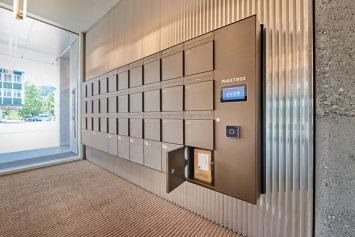
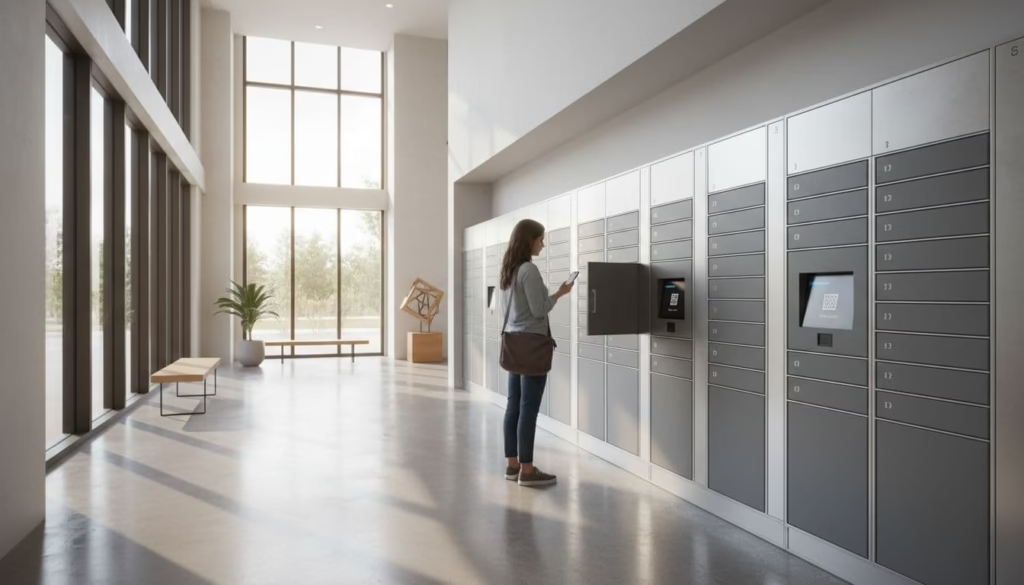
Automated locker systems — from vendors like Luxer One, Package Concierge, and Parcel Pending — give residents self-service pickup on their own schedule, often 24/7. The resident gets a notification, retrieves the package with a PIN or mobile credential, and moves on. No staff involvement. Clean audit trail. No after-hours access problem.
For carriers, a well-positioned locker bank simplifies the handoff and reduces redelivery attempts. For residents, the experience is as good as it gets in multifamily delivery — and it’s increasingly what residents in newer, better-managed properties expect.
The trade-off is cost and capacity planning. Locker systems require capital investment, ongoing software fees, and enough compartment volume to handle peak periods without overflow. Undersized locker banks become overflow problems within weeks of a busy holiday season, and once overflow starts, staff are back to manual handling alongside the lockers — the worst of both worlds.
Space is also a real constraint. A tight lobby or a building with no natural staging area may not support a full locker wall, particularly when oversized boxes are part of the regular delivery mix.
Integrating multifamily package management solutions can help streamline various operational processes effectively.
Effective utilization of multifamily package management solutions leads to enhanced resident satisfaction.
Evaluating multifamily package management solutions should be an ongoing process to adapt to changing needs.
Ultimately, the choice of multifamily package management solutions should align with property goals and resident expectations.
Amazon Hub Lockers: A Partial Solution, Not a Full Strategy
Amazon Hub Apartment Lockers are frequently pitched to operators as a free or low-cost package solution. The pitch is appealing — Amazon installs the hardware, handles the software, and operators don’t carry the upfront cost.
The limitation is significant and often misunderstood: Amazon Hub only accepts Amazon packages. UPS, FedEx, USPS, Walmart, Target, meal kit services, local couriers, and direct-to-consumer brands cannot use the system. For most multifamily properties, Amazon represents somewhere between 30 and 50 percent of total delivery volume — which means Amazon Hub, as a standalone strategy, still leaves the majority of packages in a manual process.
| Amazon Hub can be part of a package strategy. It cannot be the whole strategy — and operators who treat it as a complete solution end up running two processes instead of one. |
If Amazon Hub is part of your plan, staff still need a separate system for non-Amazon deliveries. That split creates resident confusion (which box do I use for which carrier?), staff confusion, and the operational overhead of two workflows. For most properties under 200 units, that split model costs more in daily friction than it saves in hardware investment.
Package Rooms: Lower Hardware Cost, Real Trade-Offs
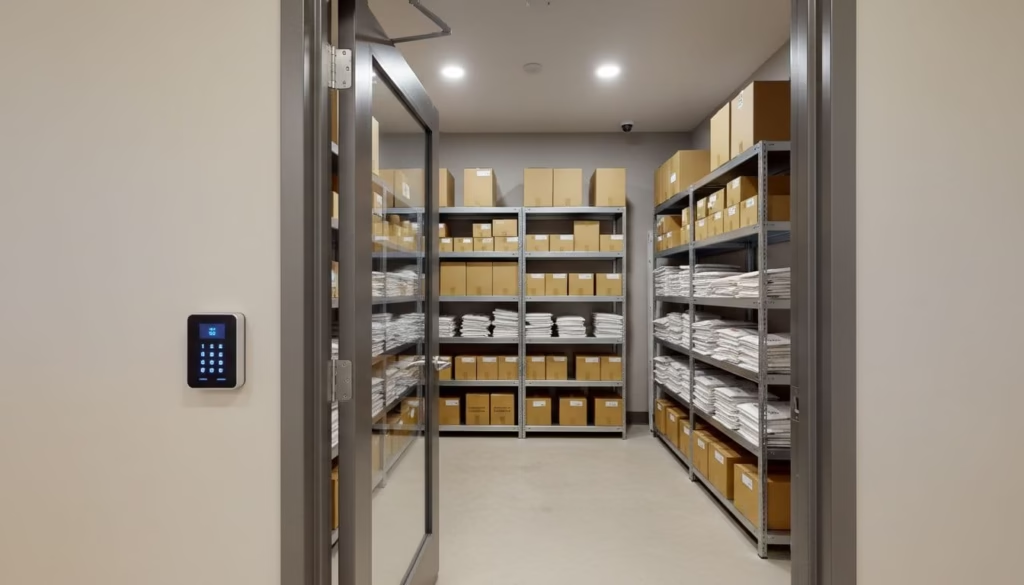
A secured package room — controlled door access, camera coverage, organized shelving — typically costs significantly less to set up than a locker system. For operators who have the space and need a first step that doesn’t require a capital-intensive hardware deployment, a package room is a legitimate option.
The risks are real and worth naming upfront. A package room gives multiple residents access to the same space, which means individual package theft can still happen inside even with camera coverage — the audit trail shows who entered, not necessarily which package they took. Overflow is also a persistent challenge. Rooms need more square footage than most operators budget for, and a single heavy-delivery week can overwhelm a room that handles normal volume fine.
Package rooms work best when they’re paired with clear intake rules, visible monitoring, staff enforcement on oversized items, and a realistic plan for peak periods. Without those elements, the room solves the access problem but creates a new management headache.
Notification and Concierge Software: Process Improvement Without Hardware
Tools like Notifii and BuildingLink organize a manual package process without adding hardware. Staff log deliveries at intake, residents get automatic notifications, pickup is tracked, and the “did you get my package” guessing game largely disappears.
The value here is real — especially for properties that are already accepting deliveries at the office and have consistent staff coverage. A structured, logged intake process with fast resident notification reduces call volume, improves chain-of-custody accountability, and gives managers data on volume and pickup patterns they’ve never had before.
The important caveat: this category improves a manual process. It doesn’t replace the labor. Staff are still receiving packages, storing them, and handling retrieval. For properties with limited staffing or after-hours access needs, software alone doesn’t solve the core problem — it just makes the existing process more organized.
Hybrid Models: Often the Right Answer for Sub-200 Unit Properties
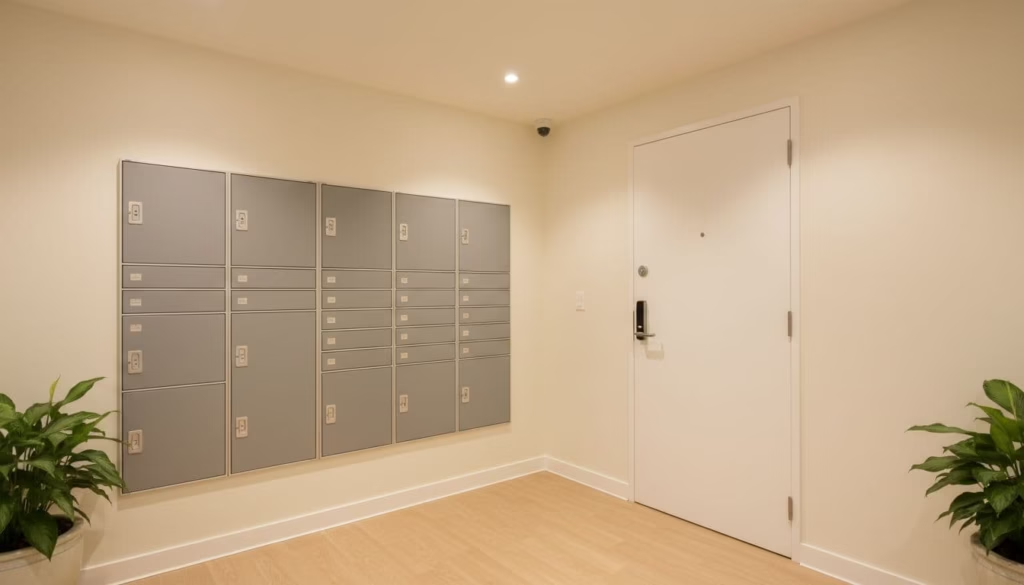
A secure package room handles standard delivery volume. A small locker bank — sized appropriately, positioned near the entry — handles after-hours pickup, high-value items, and peak overflow. The two systems work together and complement each other’s weak points.
This model spreads cost more sensibly than a full locker deployment, gives operators flexibility as volume changes, and tends to fit the physical constraints of mid-size properties better than an all-or-nothing hardware approach. It’s also expandable — if package volume grows, operators can add lockers or reconfigure the room without replacing the whole system.
How to Evaluate Multifamily Package Management Solutions Before You Buy
The wrong buying process leads to the wrong system. Start with the building and the team, not the vendor brochure.
Start With Space, Staffing, and Delivery Volume
Space comes first. If your lobby has no room for a locker bank and there’s no natural staging area, that constraint narrows your options immediately. Don’t start a vendor evaluation before you’ve walked the property and identified where a solution would actually live.
Staffing shapes the solution more than most operators realize. Is someone on-site during delivery hours? Do office hours cover the window when residents want to pick up packages? If your property is lightly staffed or self-managed, after-hours access isn’t a nice-to-have — it’s the primary requirement, and that points you toward controlled hardware rather than software-only solutions.
Check actual delivery volume before you size a system. Monthly averages hide peak behavior, and peak behavior is what breaks under-capacity systems. A property that averages 30 packages a day might see 80 during the week before a holiday — and a locker bank sized for 30 will fail at 80.
Evaluate the Full Cost Stack and Carrier Compatibility
Sticker price on hardware is the least useful number in a package management evaluation. Build the full cost picture:
- Hardware purchase or lease cost
- Installation labor
- Monthly or annual software licensing fees
- Per-package or per-transaction fees (some vendors charge these — ask explicitly)
- Support and maintenance costs
- Oversized item handling — what happens when a package doesn’t fit the system?
Carrier compatibility is non-negotiable. Verify that all major carriers — UPS, FedEx, USPS, Amazon, and regional couriers — can use the system. A locker bank that three major carriers won’t use is an expensive partial solution.
Also ask about PMS and access control integration. If you already have (or are deploying) an access control system from Post 1 of this series, a package room that integrates with the same platform can simplify credential management and reduce the number of separate systems your team manages.
Decision Matrix: Matching the Solution to the Property
This framework maps common property conditions to the most practical first move. Use it as a starting point, not a rigid prescription — every property has constraints that a table can’t fully capture.
| Property Type | Common Constraint | Recommended Solution | Why It Fits |
| Staffed 50–150 unit property | Limited budget; staff already accept deliveries | Notification software + intake rules (Notifii, BuildingLink) | Low cost, better tracking, cleaner workflow — no new hardware required |
| Self-managed or lightly staffed | No reliable office pickup window | Secure package room with access control | Supports after-hours access without turning staff into package clerks |
| Higher-volume site with overflow complaints | Frequent peak overflow; residents waiting or frustrated | Package lockers + overflow room (Luxer One, Package Concierge) | Best pickup experience; strong audit trail; handles peak periods |
| Budget-limited site, uneven volume | Can’t justify full locker install yet | Package room first; expand to hybrid later | Improves control now; leaves room to add lockers when volume justifies it |
The pattern across all four scenarios is the same: match the system to your labor reality first, then improve the resident experience where volume and budget support it. A $40,000 locker installation at a lightly staffed 60-unit property is the wrong solution even if the hardware is excellent. A $200/month notification software subscription at a high-volume property with no after-hours access is also the wrong solution. Start with the constraint, then find the system that removes the most friction within it.
With the right multifamily package management solutions, properties can significantly enhance their overall service delivery.
Package management doesn’t exist in isolation. It’s the last step in a resident’s daily entry experience — and the weakest link in that experience is the one residents remember at renewal time.
This series has worked through all three layers. Post 1 covered access control for apartment buildings — the perimeter, the shared spaces, the vendor landscape, and the questions to ask before you sign. Post 2 covered smart locks vs. smart access control — why the distinction matters, what it costs to confuse them, and how to sequence the investment. This post covers the package management layer — the final touchpoint in the resident’s daily interaction with the property’s infrastructure.
Operators who get all three right — controlled perimeter, clear unit-level access strategy, and a functional package process — have a noticeably better resident experience than most of their competitors in the sub-200-unit segment. Not because the technology is expensive or complicated, but because most independent operators in this size range haven’t connected these three layers into a coherent strategy. They’ve addressed each problem separately, reactively, when something breaks.
A coherent strategy doesn’t require a large budget or an IT department. It requires understanding what you’re buying, sequencing the investment correctly, and choosing systems your team can actually operate. That’s what this series has been about.
| Read the Full Series: The Independent Operator’s Guide to Smart Building Technology |
| Post 1: Access Control for Apartment Buildings Under 200 Units — The evaluation criteria, vendor landscape, and questions to ask before you sign. [techscribe.org/access-control-buyers-guide-apartment-properties] |
| Post 2: Smart Locks vs. Smart Access Control — Why the distinction matters, what it costs to confuse the two, and how to sequence the investment. [techscribe.org/smart-locks-vs-smart-access-control-multifamily] |
| Post 3: Package Management Is a Resident Retention Issue — Here’s the Tech Landscape. You’re reading it. [techscribe.org/multifamily-package-management-technology-guide] |
For independent guidance on multifamily technology strategy — without the vendor spin — visit techscribe.org. If you’re working through a technology decision at your property and want a sounding board, re
Let's talk multifamily tech.
I consult independently with apartment operators on managed Wi-Fi, smart building infrastructure, and technology strategy. If you're evaluating vendors, planning a deployment, or just need a second opinion — I'm happy to have a conversation.
Get in touch →No pitch. No obligation. Just a straight conversation.