Physical Address
304 North Cardinal St.
Dorchester Center, MA 02124
Physical Address
304 North Cardinal St.
Dorchester Center, MA 02124

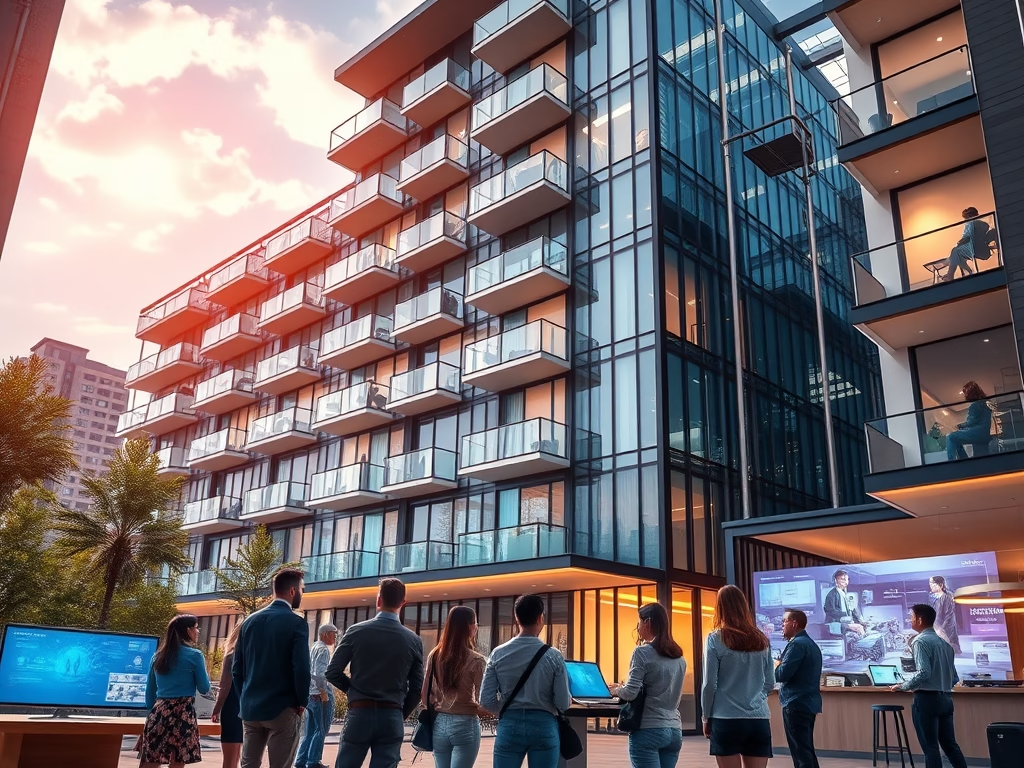
Multifamily Tech Trends 2026 indicate a shift toward operational efficiency through fewer tools amidst tight budgets and high renter expectations. Key trends include AI-driven leasing, centralized operations, enhanced fraud prevention, smart payment systems, IoT integration, and improved cybersecurity. These innovations aim to reduce vacancy days, streamline workflows, and control costs while enhancing the resident experience.
If 2025 felt like “more systems, more logins, more alerts,” Multifamily Tech Trends 2026 are shaping up to drive operators toward fewer tools for operational efficiency. Budgets are tighter amid market volatility, onsite teams are stretched, and renter expectations still demand fast answers at 9 pm.
The good news is that the best multifamily tech trends for 2026 aren’t about flashy demos. They’re about reducing vacancy days, preventing fraud, cutting utility waste, and helping teams close leases without burning out. With the supply pipeline easing in many markets, operators have room to invest in real estate technology that pays back, as highlighted in Apartments.com’s 2026 trends report.
Below are ten trends worth building into 2026 roadmaps, with practical examples and the metrics that tell the truth.
In 2026, AI-enabled leasing is moving from “answer a question” to “finish the task.” AI agents run real workflows with automation, for example replying to a lead, qualifying them, booking a tour, sending reminders, and creating a follow-up task if they no-show. Another example: Voice AI summarizes a resident call and drafts the right work order category for maintenance, advancing AI-enabled leasing efficiency.
For a multifamily-focused view of where AI is heading, see The Real Story of Multifamily AI in 2026.
Measure: speed-to-lead, lead quality, lead-to-tour conversion rates, tour-to-application conversion, leasing labor hours per lease, vacancy days.
Centralized leasing reflects the centralization of operations, less about one “call center” and more about one queue, one playbook, and consistent coverage with automation. Example: a hub team handles initial inquiries and pre-qual, then onsite teams focus on high-intent tours and closes. Another example: one centralized calendar and tour policy with self-guided tours reduces double-booking and missed follow-ups across sister sites, streamlining centralization of operations.
Many vendors are now building for this property management operating model, including in MRI’s leasing predictions for 2026 and beyond.
Measure: call answer rate, appointment set rate, applications started per lead, cost per lease, days vacant between move-out and move-in.
Fraud isn’t only a collections problem. It starts at application. Example: identity checks that match ID, selfie, and device signals reduce “synthetic” applicants and bad move-ins. Another example: stronger verification for co-signers and income docs cuts the “approved but never pays” pattern.
This trend also ties to access control. When credentials are issued, who approved them, and how fast can they be revoked?
Measure: application fallout due to verification, bad debt and write-offs, chargebacks, time-to-approve, evictions tied to fraudulent applications.
“Payment rails” just means the methods and pathways money travels, like ACH bank transfers, debit, cards, and cash pay networks. In 2026, portals are adding better autopay options, split payments, and real-time status updates for improved delinquency management. Example: a resident splits rent across two bank accounts and still meets the due date. Another example: a failed payment triggers an instant retry workflow and a clear resident message, not a late notice two weeks later. These advancements support rent growth by ensuring reliable collections.
Measure: autopay adoption, on-time payment rate, delinquency rate, failed payment rate, average days to collect rent.
More operators now treat property-wide Wi-Fi like water and power: foundational. Example: integrated solutions from a managed network support resident internet options plus smart locks with mobile access, intercoms, cameras, and work-from-home reliability. Another example: when a thermostat drops offline, IT can see the network issue before maintenance rolls a truck.
This matters because every “smart” device is only as good as its connection, directly impacting the resident experience.
Measure: Wi-Fi related work orders per 100 units, mean time to resolve outages, resident satisfaction scores, renewals and churn tied to connectivity complaints and resident retention.
Internet of Things (IoT) energy programs are widening from in-unit thermostats to common-area lighting, pumps, and runtime tracking. Example: occupancy sensors reduce heating and cooling in vacant units during turns. Another example: automation adjusts common-area HVAC schedules based on real usage, not a fixed timer.
Savings vary by property and climate, but connected controls are often cited as a way to cut utility waste meaningfully when tuned and maintained.
Measure: utility cost per occupied unit, kilowatt-hours (kWh) per unit, peak demand spikes, rebate dollars captured, resident comfort complaints.
Predictive maintenance uses sensor data and equipment signals to spot issues early. Example: leak sensors in kitchens and mechanical rooms trigger an alert for maintenance coordination before a unit floods. Another example: HVAC runtime and temperature drift point to a failing component, so a tech swaps it during normal hours instead of on a weekend.
When it’s done right, it reduces emergency calls and extends equipment life.
Measure: emergency work order rate, work order cycle time, repeat work orders, after-hours overtime spend, resident satisfaction after service.
Interoperability is the ability for systems to share data without manual re-entry, enabling seamless digital workflows. In practice, that means application programming interfaces (APIs) that actually work, plus clear data ownership to power efficient digital workflows. Example: a move-in in the property management system automatically triggers access credentials, utility setup, resident communication, and resident portal activation. Another example: a completed work order pushes cost and parts usage back to accounting without a spreadsheet upload.
Measure: manual entry time per lease, data error rate impacting vacancy levels and transaction volume, time-to-ready for move-ins, reporting time for weekly KPIs, number of systems requiring duplicate resident profiles.
As tech stacks grow, exposure grows too. In 2026, more multifamily firms are standardizing controls like multi-factor authentication (MFA), vendor access limits, and tighter device policies across their tech stacks. Example: a phishing email that used to steal a payroll login fails because MFA blocks it. Another example: a vendor breach is contained because integrations use scoped tokens for access control, not shared admin passwords.
Measure: MFA coverage rate, time to patch critical systems, number of vendor accounts with admin rights, security incidents per quarter, employee phishing test failure rate.
Privacy rules in the US keep expanding at the state level, and residents are more aware of how their data is used. In multifamily, the sensitive pieces add up fast: IDs, income docs, background checks, access logs, camera footage, even smart lock events. Example: setting retention limits for applicant documents reduces exposure. Another example: clear consent and notice flows for smart access and building cameras reduce complaints and legal risk, including features like AI-driven search that residents are increasingly using.
For broader context on real estate risk and tech adoption pressures, see ULI and PwC’s Emerging Trends in Real Estate 2026.
Measure: time to fulfill data requests, number of systems storing ID images, retention policy compliance, vendor contract reviews completed, privacy complaints per 1,000 units.
The best 2026 plans don’t chase every tool. They pick a few bets that connect leasing, operations, and risk into one measurable story across property types like build to rent. Start with the metrics that matter, like conversion, vacancy days, delinquency, work order cycle time, and churn, then build your stack around them to drive net operating income, improve resident experience, and fuel rent growth.
If one theme ties these multifamily tech trends together, it’s control: control of time, costs, and risk. Which trend would show results in 90 days at your properties?